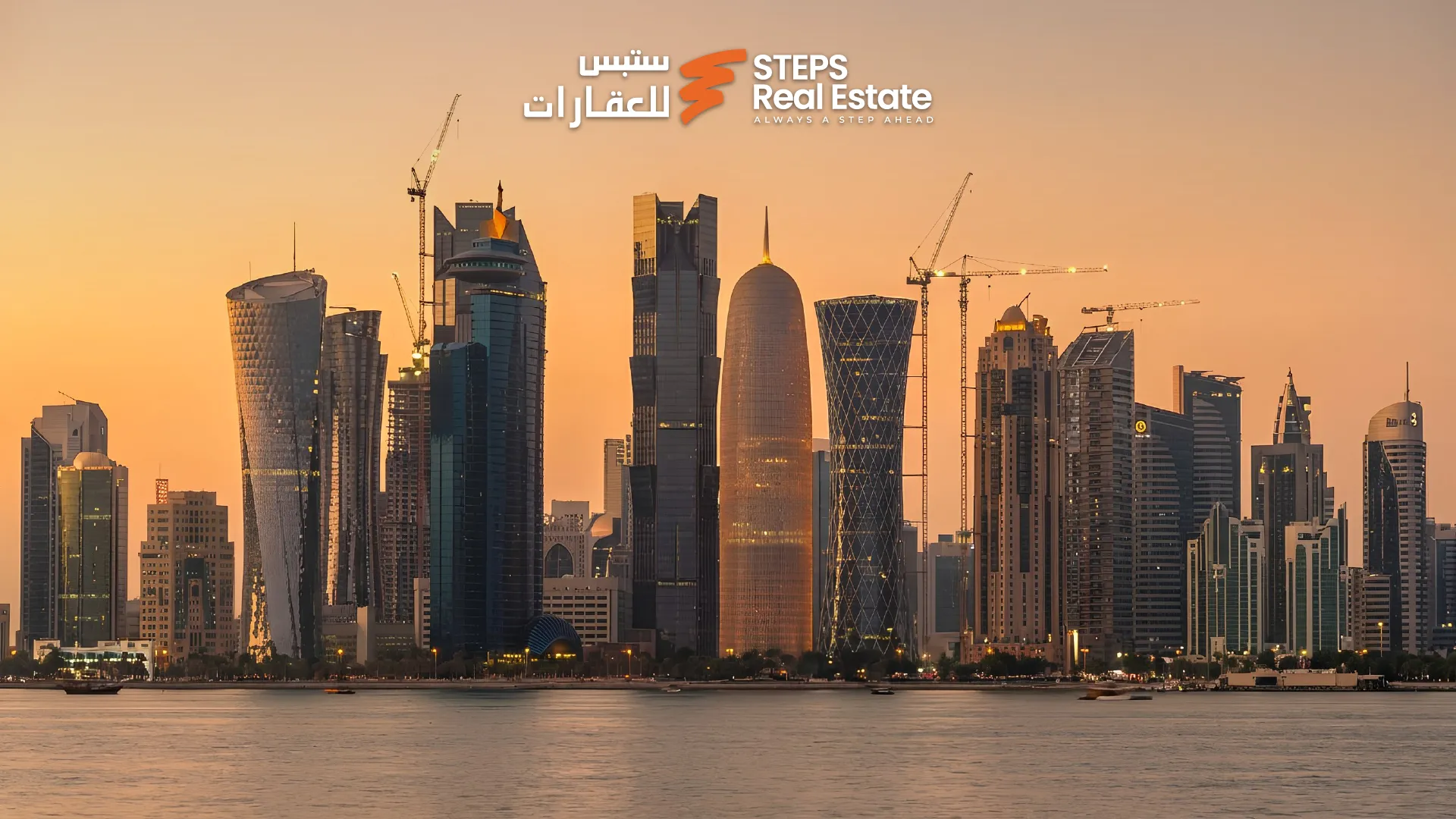
Qatar Real Estate After Crisis: Strong Recovery Outlook
During times of crisis, real estate markets often experience a slowdown. However, in Qatar, this slowdown reflects caution rather than weakness, as many buyers and investors prefer to pause and wait for clarity before making decisions.
In such circumstances, some buyers and investors tend to pause and delay decisions until the picture becomes clearer. Therefore, a decline in the number of transactions during or immediately after a crisis should not be seen as a sign of structural weakness in the market, but rather as a normal response driven by caution.
In Qatar’s case, however, the future of the Qatar real estate market should not be assessed based only on short-term reactions. It must be understood through three core elements: the strength of the economy, the stability of the population structure, and the nature of demand within the local market.
Qatar Is Not a Fragile Market
Some markets rise quickly and then fall quickly, but this description does not easily apply to the Qatari market. Real estate demand in Qatar is not based only on short-term speculative waves. It is supported by a stable security, economic, and institutional environment, as well as by a population that lives in the country for work, stability, and long-term life building.
It is true that a large share of Qatar’s population consists of expatriates. However, actual experience has shown that Qatar is not merely a temporary stop in the traditional sense. Rather, it is an environment of attraction and stability. This is a very important factor because real estate, by nature, is more closely linked to stability than to rapid reactions.
The Population Structure Gives an Important Indication of Market Strength.
When looking at Qatar’s monthly population series between 2016 and 2025, we can see that the population in 2016 was around 2.4 to 2.6 million people and then gradually increased in the following years, reaching approximately 3.21 million in December 2025 according to the series used in this analysis.
It is true that Qatar experienced strong growth during the World Cup period and the exceptional activity associated with it. However, the more important point is that the population base remained significantly higher afterward than it had been before that phase. This suggests that a meaningful part of the growth was not entirely temporary but rather reflects a relatively genuine and stable population base.
This highlights a key point:
The real estate market in Qatar is supported by demand linked to housing and stability, not only by temporary or exceptional factors.
Market Figures Confirm the Strength of Real Estate Activity
According to the official annual real estate bulletins, Qatar recorded 3,548 real estate transactions in 2024 with a total value of QAR 14.52 billion, while activity rose in 2025 to 5,154 real estate transactions with a total value of QAR 20.98 billion.
On the mortgage side, 2024 recorded 1,492 mortgage transactions with a total value of QAR 64.03 billion, while 2025 recorded 1,487 mortgage transactions with a total value of QAR 39.52 billion.
When combining the two years, the total number of real estate transactions reached 8,702, compared to 2,979 mortgage transactions. This means that direct real estate transactions accounted for around 75% of all recorded market activity during 2024 and 2025, while mortgages represented only around 25%.
This is highly significant, because it clearly indicates the strength of purchasing power in the Qatari market and confirms that the market is not moving only through financing but through broad-based direct purchasing activity. This, in turn, reinforces the image of the market as one driven by genuine demand, not by leverage alone.
What Do These Numbers Mean?
The high proportion of real estate transactions compared to mortgage transactions does not only indicate market activity. It also suggests that a large share of the movement comes from buyers who have the capacity to execute directly. This reflects resilience in demand and suggests that the local market in Qatar rests on a more stable base than many other markets that depend more heavily on financing or on rapid speculative flows.
Based on the nature of the Qatari market and its population structure, it can also be said that a broad segment of this demand is linked to stability, actual use, or medium- to long-term holding, rather than short-term speculation. For this reason, in times of crisis, the more likely behavior is to delay the decision, not cancel it.
Why Is Qatar Expected to Recover Quickly?
This does not come down to one factor but to a combination of interconnected factors:
First, the strength of the Qatari economy and its financial resilience and capacity to absorb shocks.
Second, the readiness of the state and the speed of response. This has been proven in more than one phase, as institutions in Qatar have shown a strong ability to preserve stability and maintain the continuity of services and business activity.
Third, the nature of real estate demand in Qatar . When a large part of demand is tied to real stability, a crisis often leads to postponement rather than cancellation. A buyer who is planning to purchase for housing or a stability-related investment may wait for a while but does not disappear from the market.
Fourth, the stable security, social, and cultural environment, which is especially important in real estate because property decisions are inherently long-term and are strongly influenced by the general sense of safety and confidence in the future.
What Could Happen After the Crisis Ends?
The most logical scenario for the Qatari market is neither an immediate full rebound from day one nor a prolonged freeze, but rather a path that is closer to three stages:
At first, there may be a short period of caution, during which some buyers and investors wait to confirm that the situation has stabilized and the outlook has become clearer.
Then comes the phase in which delayed decisions begin to return, and here the market may see notable activity over a short period due to what can be described as pent-up demand; that is, demand that already existed but was postponed because of the circumstances.
After that, there may be a slight period of relative calm once part of this delayed demand has been absorbed before the market returns to a balanced and normal pace.
This scenario appears more logical in Qatar than in some other markets, because local market fundamentals do not point to a deep internal weakness, but rather to a temporary external impact on decision-making behavior.
The Qatari Market Is Closer to Postponement Than Cancellation
One of the most important things to understand at this stage is that a wide segment of participants in the Qatari market does not operate solely on the logic of quick speculation but on the logic of stability. This difference is essential.
A real estate decision in Qatar, whether by an end user or by a medium- to long-term investor, is often tied to housing, asset organization, value preservation, or preparation for a future stage. Therefore, in times of crisis, much of this demand is not canceled but postponed.
And this is where the strength lies. A market that experiences postponed decisions has a strong chance of returning; unlike a market whose demand is fragile or entirely speculative.
Conclusion
A slowdown in the real estate market after a crisis is natural and should not be interpreted as structural weakness. In Qatar’s case, the picture becomes clearer when looking at the fundamentals: a strong economy, a state that is ready and quick to act, a stable environment, a population base that is more stable than many assume, and a real estate market that demonstrated clear activity in 2024 and 2025 in terms of both transaction volume and total value.
Therefore, the most logical conclusion is not that real estate demand in Qatar disappears, but that part of it is merely postponed. Once the crisis ends and clarity returns, the Qatar real estate market is likely to witness a relatively fast recovery, driven by pent-up demand and by the strong fundamentals that distinguish it from many other markets in the region.
At Steps Real Estate , we help you navigate the market with confidence—whether you're looking to invest, buy, or secure the right opportunity at the right time. Our team is here to guide you through every step, ensuring you make informed and strategic decisions in Qatar’s evolving real estate market.
Get in touch with Steps Real Estate today and take the next step toward your ideal investment or property.