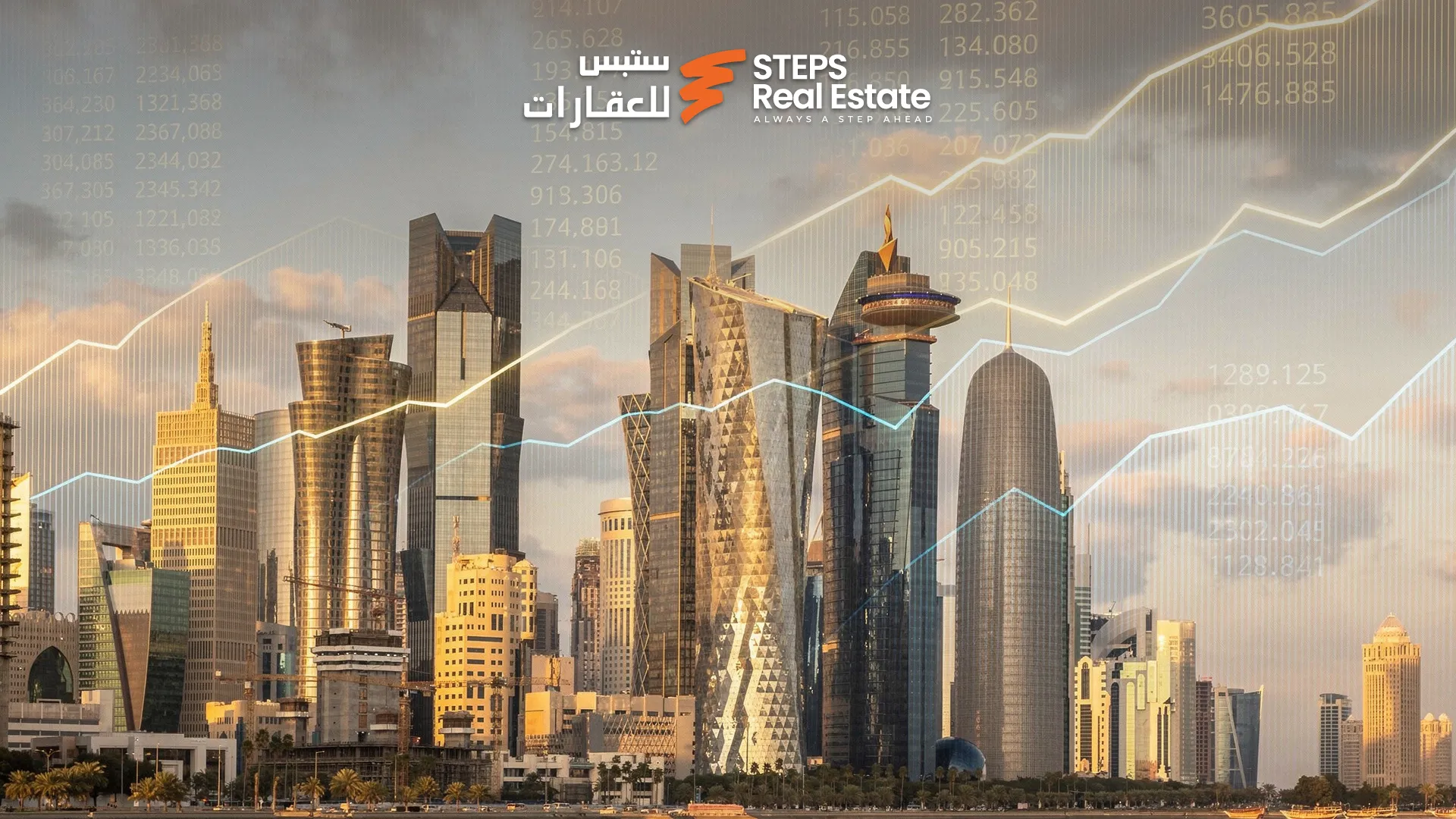
The global economy is currently navigating a period of uncertainty. Rising geopolitical tensions continue to influence investor sentiment, energy markets, and overall financial stability. While these developments are not directly tied to real estate, they play a major role in how investors allocate capital and manage risk.
As a result, many investors are becoming more cautious—focusing on stable, well-regulated markets while stepping away from speculative or overheated opportunities. Qatar remains on the radar, but with a more selective and calculated approach.
For investors, this slowdown can create opportunity. With less urgency in the market, buyers have more room to negotiate, explore options, and make well-informed decisions. Periods like this often come before the next growth cycle, especially in markets supported by solid fundamentals.
Qatar continues to offer those fundamentals, including economic stability, long-term development plans aligned with Qatar National Vision 2030, and ongoing infrastructure expansion. These factors support future demand and long-term value.
In this context, the current market is not about short-term gains, but about strategic positioning—entering at a calmer stage before activity begins to rise again.
Qatar Real Estate Market 2026 – Key Facts
Total real estate sales value in 2025: QAR 26 billion
Market growth compared to 2024: about 45 percent
Real Estate Price Index (January 2026): 223.99
Prime investment areas: Lusail, The Pearl, West Bay
The 2008 Financial Crisis and the Shift Toward Regulation
Before 2008, Qatar’s real estate sector experienced rapid expansion driven by hydrocarbon revenues, population growth, and large-scale infrastructure investment.
Between 2006 and 2007, transactions surged from 4,017 to more than 9,004 deals. While the global financial crisis caused a slowdown, with activity dropping to just 284 transactions by August 2008, the decline in Qatar was significantly less severe compared to other global markets. Supported by its robust economic fundamentals, Qatar's real estate sector recovered remarkably faster than most of its international peers.
In response to the crisis, Qatar introduced key reforms, most notably the Real Estate Price Index (REPI), improving transparency and standardizing property valuation.
This marked a turning point, transforming the market into a more structured, regulated, and data-driven sector.
Unlike the 2008 financial crisis, which was driven by financial instability and liquidity
The Oil Price Collapse (2014–2016) and Market Resilience
The sharp decline in global oil prices between 2014 and 2016 impacted real estate activity across the GCC. In Qatar, transaction volumes dropped by approximately 34 percent in 2015.
Despite this, property prices remained relatively stable. Strong demand, combined with a shortage of nearly 50,000 residential units in Doha, supported values.
This supply-demand imbalance played a key role in maintaining price stability. Over time, the market began to decouple from direct reliance on hydrocarbon revenues, becoming increasingly driven by real demand and infrastructure development. Qatar’s strong sovereign reserves further supported economic resilience during this period.
Regulatory Strengthening and Market Maturity (2017–2020)
Following regional shifts in 2017, Qatar accelerated regulatory reforms and strengthened market self-sufficiency. Supply chains were enhanced, local production increased, and the investment environment improved.
These developments reinforced market resilience and marked a clear transition toward a more mature and stable real estate sector.
Each economic shift during this period contributed to strengthening the market’s structural and regulatory foundation.
Foreign Ownership Laws and International Investment
A major milestone came with Law No. 16 of 2018, allowing foreign investors to purchase property in designated areas.
The law introduced 9 freehold zones and 16 usufruct zones, opening the market to international buyers.
Investors purchasing property worth QAR 3.65 million or more became eligible for permanent residency, significantly enhancing the appeal of real estate investment in Qatar.
The link between property ownership and residency rights has further strengthened investor demand, particularly among international buyers seeking long-term stability.
Regulatory frameworks, including those introduced by the Qatar Financial Centre, have enhanced transparency and attracted institutional capital.
The 2022 FIFA World Cup and Infrastructure Transformation
The 2022 FIFA World Cup acted as a major catalyst for real estate development. Billions dollars were invested in infrastructure, transportation, and urban expansion.
Major projects such as Lusail City, Msheireb Downtown Doha, and The Pearl reshaped the country’s urban landscape.
Following the tournament, the market experienced a controlled adjustment rather than a downturn. Residential prices declined modestly by around 2 to 4 percent in 2024, reflecting a healthy recalibration.
Unlike many global markets that face oversupply after large-scale events, Qatar managed supply levels effectively.
Importantly, new supply was gradually absorbed through population growth, investment demand, and government-backed initiatives, preventing sharp price declines.
Qatar Real Estate Market 2025: Strong and Sustainable Growth
The market rebounded strongly in 2025, with total transaction value reaching approximately QAR 26.02 billion—an increase of about 45 percent compared to 2024.
Unlike earlier cycles, this growth was driven by end-user demand and high-value completed properties rather than speculative off-plan activity.
Buyer demand has shifted toward long-term investment opportunities, reflecting increasing market maturity and confidence.
The market is also attracting high-net-worth individuals and institutional investors seeking stable, income-generating assets.
Qatar Real Estate Market 2026: Stability and Investor Confidence
The positive momentum has continued into 2026. The Real Estate Price Index reached 223.99 points in January, indicating stable property values.
Mortgage activity further reflects market confidence. In January 2026, 99 mortgage transactions were recorded, totaling QAR 4.918 billion.
Doha accounted for over 60 percent of total mortgage value, reinforcing its position as the primary real estate investment hub.
The strong financing activity highlights confidence from both investors and financial institutions in the long-term stability of the Qatar real estate market. Stable financing conditions and accessible mortgage options have also played a key role in supporting demand.
Residential Real Estate Trends
The residential sector remains a key pillar of the market, with a well considered supply.
Demand has shifted toward larger homes, with villas becoming increasingly attractive due to evolving lifestyle preferences.
Prime locations such as The Pearl, Lusail Marina, and Viva Bahriyah continue to command premium prices.
In these areas, rental yields typically range between 6 and 8 percent, making Qatar competitive compared to other GCC markets.
Average property prices in premium waterfront areas can exceed QAR 14,000 per sqm, reflecting strong demand for high-quality developments.
Continued population growth and demand from expatriates remain key drivers of the residential real estate market.
This reflects a shift toward integrated, high-quality communities offering lifestyle and long-term value.
Market performance is increasingly driven by asset quality, location, and tenant demand rather than general market trends.
While premium properties perform strongly, older or secondary assets are experiencing pricing pressure due to increased competition.
High occupancy levels in key areas further confirm sustained demand.
Commercial and Hospitality Real Estate
Commercial real estate continues to evolve alongside economic diversification.
Prime office districts such as West Bay remain highly attractive, particularly for Grade A office spaces, while secondary office properties are facing increased competition.
Retail demand is increasingly shifting toward experiential and lifestyle-driven destinations rather than traditional formats.
The hospitality sector continues to grow, supported by rising tourism. In 2025, visitor numbers reached approximately 5.09 million, with hotel occupancy around 70 percent.
Why Qatar Real Estate Remains Attractive for Investors
Several key factors continue to support real estate investment in Qatar:
- Strong economic stability supported by sovereign reserves
- Foreign ownership opportunities in prime locations
- Attractive rental yields and long-term capital appreciation potential
- A more stable and less volatile market compared to other GCC countries
- Ongoing infrastructure development and urban expansion
- Sustainability and ESG-driven development enhancing long-term value
- A shift toward long-term investment rather than speculative activity
- The diversity of asset classes—including residential, commercial, hospitality, and mixed-use developments—allows investors to diversify risk within the Qatar real estate market.
- The growing secondary market and increasing transaction volumes also provide investors with clearer exit opportunities and improved resale liquidity.
- The consistency of regulatory frameworks in Qatar reduces investment risk and enhances long-term market predictability.
- Ongoing project pipelines are being delivered in phases, helping maintain a balanced supply-demand dynamic.
- Compared to other regional markets, Qatar offers a more stable pricing environment with lower volatility.
Investors working with trusted agencies such as Steps Real Estate can better identify high-potential opportunities across key locations in Qatar.
Conclusion
Over the past two decades, the Qatar real estate market has evolved into a highly resilient and mature sector.
Each major challenge—from the 2008 financial crisis to the pandemic—has strengthened the market’s regulatory framework and long-term stability.
The strong growth recorded in 2025, combined with continued financing activity in 2026, reflects sustained investor confidence and market liquidity.
While certain segments, particularly older properties, may face pricing pressure, this reflects a healthy and maturing market rather than a structural weakness.
More importantly, the market today is driven by real demand, institutional confidence, and long-term planning—not short-term speculation.
As global uncertainty continues, Qatar is not only keeping pace with global real estate trends but also positioning itself ahead of them.
Frequently Asked Questions
Is real estate in Qatar a good investment?
Yes. The market offers strong infrastructure, economic stability, and foreign ownership opportunities in designated areas.
Is Qatar real estate a safe investment during global economic uncertainty?
Yes. Supported by strong sovereign reserves, proactive government regulations, and a shift toward real end-user demand, Qatar has proven its historical resilience through multiple global crises. In 2026, it stands out as a secure, low-volatility "safe haven" for international investors looking to protect and grow their capital.
Can foreigners buy property in Qatar?
Yes. Foreign investors can purchase property in freehold zones such as Lusail, The Pearl, and West Bay Lagoon.
What are the best areas to invest in Qatar?
Top locations include Lusail City, The Pearl Island, and West Bay due to their infrastructure, demand, and long-term growth potential.
What is the future outlook for the Qatar real estate market?
The market is expected to grow steadily, supported by infrastructure development, foreign investment, and long-term national planning.
Call to Action
Looking to invest in the Qatar real estate market in 2026?
Explore premium opportunities in Lusail, The Pearl, and West Bay with Steps Real Estate and secure your next investment today.